Driss’s fatal road collision
The ForgivenDriss’s fatal road collision is the turning point that makes David Henniger and Jo Henniger’s private crisis consequential beyond their marriage. In a sudden loss of visibility, David continues driving despite Jo’s warning, and their car strikes a young man selling fossils by the roadside. The collision kills Driss; what follows is not only the arrival of the police but an uneasy chain of decisions about the body, the account of what happened, and the meaning of calling the death an accident.
The Roadside Collision
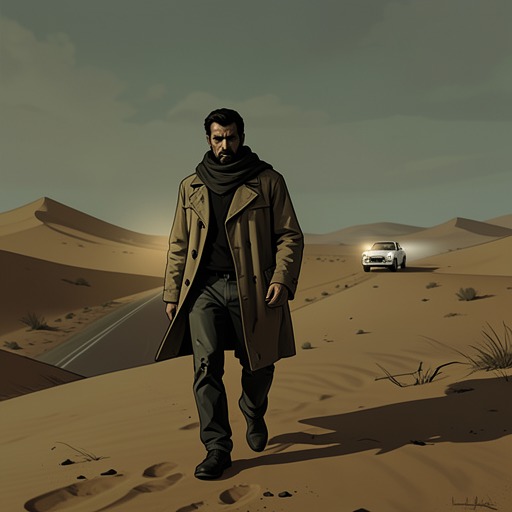
The encounter takes place as a gust of sand obscures the moon and briefly hides the road. David and Jo are already arguing in the car. Jo catches his arm; David misses the brake pedal before finding it, but does not stop. When Jo tells him to switch on the high beams, the light reveals two men at the roadside, running toward the car with raised hands. One holds a cardboard sign advertising fossils. Jo regards the approach as a scam, yet tells David to stop. He keeps moving, and the car strikes one of the men.
The gap between warning and action defines the event. Jo’s request is clear, and the men have made themselves visible, but David’s continued movement carries the car past the point at which stopping could prevent the collision. The sandstorm supplies an immediate condition of danger and confusion; it does not erase the couple’s different responses to that danger. The narrative presents the impact as happening too quickly for Jo to think through, while the recognition of what it means arrives with the loss of her confidence in the future. The collision thus changes the scene in an instant from a quarrel about the road to an irreversible death.
The Body at the Estate
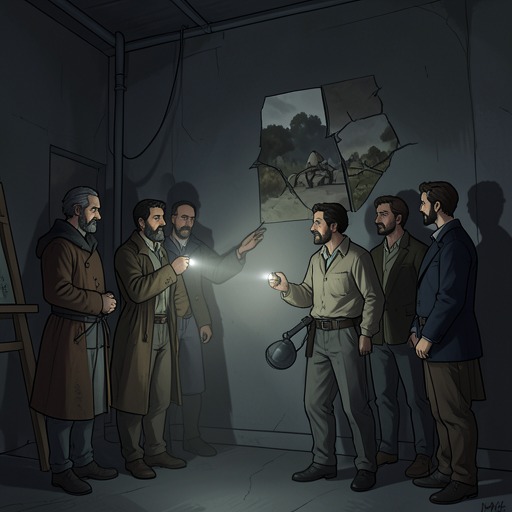
Rather than leave the victim where he was, the Hennigers bring him with them in their Toyota Camry to Richard Galloway’s estate. They are in a foreign country, do not know whom to call, and have taken the body into the car; the decision is described as logical to them, even as its consequences make their arrival profoundly awkward. Staff gather around the vehicle with flashlights. Richard sees a young man, about twenty, slender and tall, with a tattoo on his right hand and an old scar on his left. Hamid identifies him as being from the south. The identity of the dead man is Driss.
Richard tells the staff not to clean the car and says the police in Taza must be called. The instruction makes the vehicle part of the immediate aftermath rather than something to conceal or restore before the authorities arrive. The Hennigers are taken into the house, while Driss remains in the car until the staff are told to move him somewhere the guests will not wander. The practical management of the scene—where to put the body, whether to clean the car, whom to notify—proceeds alongside the guests’ ordinary evening, which has not yet ended. The collision has entered the estate, but the social occasion continues around its consequences.
Police Account and Official Classification
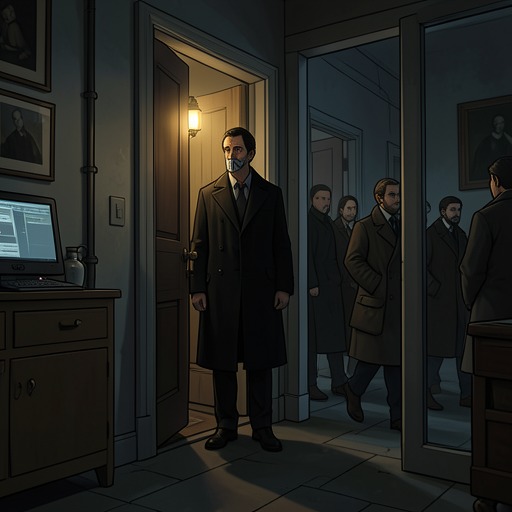
Yassine Benihadd has David go through the details of the accident. David attributes the collision to the sudden sandstorm and says they were lost. The account is met with doubt: the moon is now clear, and Benihadd asks whether there was only one man. David answers that there was one. This exchange matters because Jo’s view of the roadside encounter included two men, one carrying the sign. The difference between what she saw and David’s answer becomes a consequential omission in the account, even though the supplied scene does not establish what David intends by it.
David apologizes and says that he and Jo are devastated. Benihadd nevertheless tells them that the death will be recorded as accidental and hopes they can enjoy the rest of the weekend. The official classification offers a settled description of the event, but it does not settle the Hennigers’ private knowledge of how it happened. Jo wants to sleep; David later embraces her, and both are left unable to speak easily. The legal term and the emotional reality occupy different registers: one assigns the death a category, while the other remains lodged between the couple as an unmanageable fact.
Immediate Aftermath and Significance
The police do not take Driss away that night. Benihadd explains that his post has no morgue and that arrangements will have to wait until the next day; the body is left in an air-conditioned garage, with a man keeping vigil nearby and praying beside mint tea. David thinks about the refusal to remove the body, and the Hennigers return to the chalet without a servant. The delay gives the death a continuing presence at the estate: it cannot be made into a completed administrative matter simply by moving the couple away from the car.
The event also establishes a tension between circumstance and responsibility that persists beyond the road. The sandstorm, the sudden darkness, and the briefness of the impact explain the conditions in which the collision occurred; Jo’s appeal to stop and David’s failure to do so keep the couple’s choices in view. Their act of bringing Driss with them is a practical response to being lost and unsure whom to contact, but it also makes the dead man physically present at their destination. The police record an accident, while the mismatch between Jo’s observation of two men and David’s statement that there was one leaves a troubling discrepancy inside that official account. The collision therefore becomes both a death and the beginning of an unresolved reckoning for the Hennigers.